Let’s briefly overview the three tests you’ll need to take during the initial stage of Maven’s hiring process. I describe each test in more detail in their dedicated tabs, so make sure to check them out.
Maven Securities Numerical Test
The Maven Securities Numerical Test contains 55 basic math questions of various topics, to be solved in 21 minutes.
The test is video-proctored, and you may not use a calculator, pen, or paper.
See the Numerical Test tab for detailed information + samples.
(Illustration)
Arctic Shores Assessment
The second portion of the assessment is taking 5 Arctic Shores gamified tests. Each game lasts around 5-15 minutes, and is designed to measure one of five main traits:
Numerical ability
Pattern recognition
Focus
Empathy
Persistence
See the Arctic Shores tab for detailed information + samples.
(Illustration)
Maven Securities Probability Test
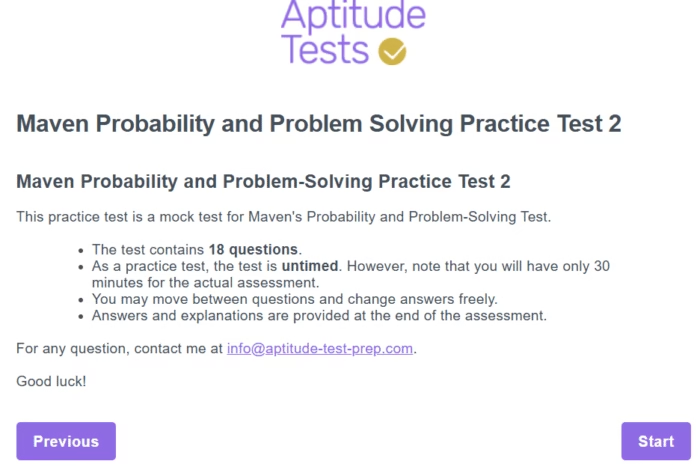
The Maven Securities Probability and Problem-Solving Test contains 18 questions, most of them in probability, but with several in logic and general mathematical problem-solving. You will have 30 minutes to complete the test.
The test is video-proctored, and you may not use a calculator. You can, however, use pen and paper.
See the Probability Test tab for detailed information + samples.
Test Invitation
Three separate test invitations will be sent to you.
The first will be to either the Numerical Test or Probability Test, depending on the job. The invitation for the Arctic Shores test will be sent alongside the first test invitation.
Once you successfully complete the first two tests, the invitation to the third will be sent.
You will have 7 days to complete the numerical test, 5 days for the probability test, and 14 days for the Arctic Shores assessment.
Numerical Test Invitation
Arctic Shores Assessment Invitation
Maven Probability Test Invitation
Maven Securities Numerical Test
General Overview
The very first test you will need to take is the Numerical Test. It contains 55 math questions to be solved within 21 minutes.
Topics covered in the test are:
Basic calculations (addition, subtraction, multiplication, and division)
Number sequences
Approximations
Percentages
Powers
The test will randomly mix questions of these topics.
You will have 5 answer options for each question, only one of which is correct.
Advanced Tip
Unlike other numerical assessments, you can solve the questions on the Maven Numerical Test in any order you’d like. It may be a good idea to identify the areas in which you are more skilled and solve them first.
Administration and Proctoring
You will be recorded throughout the entire test, so you will need to have your webcam and mic on.
You are not allowed to use a calculator, pen, or paper during the assessment.
Navigating out of the test tab or window will immediately eliminate the session and will disqualify you.
Scoring
For every correct answer you will gain 1 point. Wrong answers or unanswered questions gain you no points. Therefore, it is always better to guess than leave a question unanswered.
Free Sample Questions + Tips
Here you’ll find sample questions adapted from the Maven Securities Numerical Test, in 2 main topics:
Calculations and approximations – You don’t need me to teach you how to calculate. Instead, I’ll show you some of the tips you can use during the test to save time.
Sequences – Here I will try to get you familiar with some common sequences used in the test.
Let’s go!
Question 1 – Calculations
8843 – 4569 – 327 = ?
3947
3944
3954
3949
4054
Answer + Tailored Tip
The correct answer is 3947.
Tailored Tip!
While at first glance, the answer options suggest that an accurate calculation is needed, that isn’t the case.
The last digit trick is going to help you to solve this problem instantly. Subtract only the last digits, in order:
(2)3 – 9 – 7 = 7
Hence, the last digit must be 7.
(The number in the brackets is provided just for explanatory purposes. It is quite simple to mentally perform this calculation).
Advanced Tip
That last digit trick is pretty basic! What if I have several options with the same last digit?
Check out the next question.
Question 2 – Calculations
10532 – 4335 – 1489 = ?
4718
4628
4778
4708
4758
Answer + Tailored Tip
The correct answer is 4708.
Tailored Tip!
In this case, all answer options end with the same digit – so this trick doesn’t help.
However, we can see that the tens digit is different in each response, so let’s find it:
Step #1 – Find out how many tens you need to borrow
Using the first digit trick:
(2)2 – 5 – 9
Without even looking at the result (8, naturally), we know that we need to borrow two tens to be able to complete the calculation of the ones.
Step #2 – Use the last digit trick on the second-last digit (subtracting borrowed)
(2)3 – 2 (borrowed) – 3 – 8 = (1)0
This means that the tens digit of the result should be 0.
Question 3 – Calculations
X / 9 = 4 / X
X = ?
1.5
2.25
4
6
12
Answer and Tailored Tip
The answer is 6.
The shortest way to solve such a question is:
X2 = 9 x 4 = 36
X = 6
Question 4 – Sequences
-1, 16, -81, 256, -625, 1296, 2401, ?
-5006
-4024
-3296
-4096
-5696
Answer and Tailored Tip
This sequence follows the rule an = (-1)nn4
Therefore, the next number in the sequence is -84 = -5096
Tailored Tip!
Since no aids are allowed during the test, it will come very handy to remember by heart things like commonly used powers.
Question 5 – Sequences
4, 12, 8.3, 24.9, 23.05, ?
66.15
67.15
68.15
69.15
99.15
Answer and Explanation
The correct answer is 69.15.
This series alternates between multiplying by 3 and subtracting a decreasing number, as follows:
4 x 3 = 12
12 – 3.7 = 8.3
3 x 4 = 24.9
9 – (3.7/2) = 23.05
Therefore, the next number should be 23.05 x 3 = 69.15.
Tailored Tip!
Oftentimes, one of the rules of the alternating series will be VERY hard to spot. However, before wasting valuable time trying to crack it, think if figuring out only one of the rules is enough to solve the question – as in the example we’ve just seen.
Arctic Shores
Once you complete the Maven Numerical Test, you will likely be required to take an Arctic Shores assessment.
The Arctic Shores Assessment is a collection of various gamified tests. Each employer may choose a different composition of these games to conduct to their candidates.
Maven conducts 5 tests of the Arctic Shores collection, taking around 40 minutes to complete:
Balance– Measures your numerical abilities. 10 minutes.
Order – Measures your ability to recognize patterns and understand rules. 17 minutes.
Direction – Measures your focus and attention. 3 minutes.
Expression – Measures your empathy. Untimed, approx. 4 minutes.
Security – Measures your persistence and willingness to learn. Untimed, approx.7 minutes.
(Illustration)
Below is an overview of each gamified test.
Balance
The Balance game measures your numerical abilities.
You will be presented with 2 or 3 scales, on which various shapes are balanced.
Your task is to interpret the information and fill in the missing shapes on the empty scale so that it is also balanced.
You have 60 seconds to complete this task.
There are a total of 10 rounds. Each round will be more challenging than the previous one.
The balance test is an exceptionally challenging test, and that’s why I made a dedicated guide for it.
Balance Sample Question
For the solution to this particular question, please refer to my Balance Test guide.
Order
The Order game measures your pattern recognition and understanding of rules.
You will be presented with a sequence of shapes and will need to decide what the next shape should be.
You will have to manually select the shape, color, position, rotation, and size from the bottom menu.
You have 60 seconds to answer the question.
There are a total of 17 rounds, each more challenging than the previous.
Order Sample Question
Answer and Explanation
The correct answer is:
The red circle changes position between the top left corner and bottom left corner.
The blue triangle does not change location, only size.
The yellow square both moves counterclockwise between the corners, and rotates 45 degrees with every move.
The Direction game measures your focus, attention, and concentration.
You will be presented with a set of arrows in various directions.
You must focus on the middle arrow and indicate its direction, ignoring all arrows on the sides.
However, sometimes the middle arrow will be surrounded by Xs. In that case, you should not indicate any direction.
The arrows will appear on the screen for a very short time – maintain your attention so you don’t miss them!
Throughout the test, you will receive feedback for whether your answers are correct, incorrect, or given too late.
There are a total of 80 rounds. The game lasts around 3 minutes overall.
Expression
The Expression game measures empathy and emotional intelligence.
You are presented with a computer-generated face showing some emotion. You need to identify that emotion, from a list of 7 options.
There is no time limit to choose the emotion
The expressed emotions can be very subtle and vague.
There is a total of 60 rounds.
Advanced Tip
Based on the recommendations of past test-takers, taking your time for just a little bit before choosing the emotion could increase your score.
Security
The last, and likely most notorious game of the Arctic Shores games is the Security game, also known as the Safe game.
Here, you will be required to open a safe door.
To open the door, you need to stop the rotating, colored area once it reaches the marked digit.
The rotation of the colored area grows increasingly more difficult in speed and pattern.
If you make an error at any point, the door will reset, and you’ll go back to the starting point.
The game has no time limit, and you can choose to end it any time.
Advanced Tip
Unlike what is commonly believed, the task here is not to “crack” the game (although it could be a fun bonus).
The game measures your persistence and learning, and therefore the more time you spend trying to solve it, and the more proactive and experimental your approaches become – the higher your score is likely to be.
Maven Probability and Problem-Solving Test
After receiving multiple requests from candidates, I have published a tailored prep course for Maven’s Probability and Problem-Solving test!
Maven’s probability test may come before or after the numerical test, depending on the job. It contains 18 questions to be solved within 30 minutes.
Some of the topics covered in the test are:
Basic probability models
Permutations and combinations
Dice rolls and card draws
Bayes’ theorem
Logic and problem-solving
You will have 5 answer options for each question, only one of which is correct.
Pro Tip
Similar to the numerical test, you can solve the questions on the Maven Probability Test in any order you’d like. It may be a good idea to identify the areas in which you are more skilled and solve them first.
Administration and Proctoring
You will be recorded throughout the entire test, so you will need to have your webcam and mic on.
You are not allowed to use a calculator during the assessment, but you are allowed a pen and paper.
Navigating out of the test tab or window will immediately eliminate the session and will disqualify you.
Scoring
You will gain 1 point for every correct answer and lose 1 point for an incorrect one. Unanswered questions gain no points. Therefore, unlike on the numerical test, it is better to leave a question blank than to guess.
Free Sample Questions + Tips
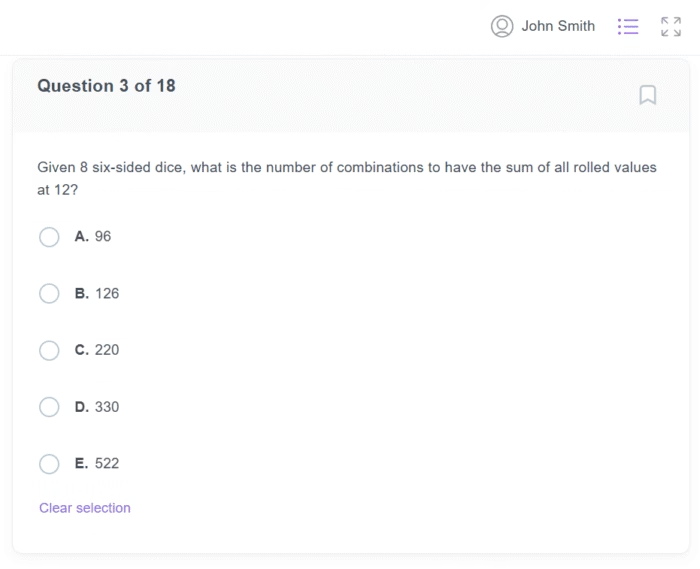
Here you’ll find two sample questions adapted from the Maven Securities Probability Test.
Let’s go!
Question 1
A soft drink company prints one of five letters under the caps of its drinks: P, R, I, Z, and E. Collecting all five letters earns a prize. If the probability of finding each letter is equal, and a drink costs $2, what is the average cost one should pay to win a prize?
$22.83
$25.14
$32.05
$34.12
$55.15
Answer and Explanation
This is a classic case of coupon collector’s problem. This model can be defined as: “given n coupons, how many coupons do you expect to draw (with replacement) before having drawn each coupon at least once?”
Let’s briefly explain the general idea, then move on to the particular solution.
Coupon Collector’s Problem
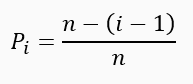
In this model, the probability of drawing a new coupon is defined as:
Where:
i – the number of found coupon
n – the total number of coupons
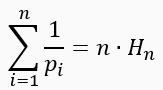
Hence, the expected number of draws until all coupons are collected is:
Hn is the nth harmonic number.
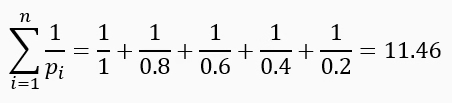
So, in our case:
P1 = 1
P2 = 0.8
P3 = 0.6
P4 = 0.4
P5 = 0.2
The expected number of samples E to find all letters is:
And the cost is:
11.416 x $2 = $22.83
Pro Tip
The test’s time constraints make it virtually impossible to solve the questions without being super familiar with a variety of common probability models (stars and bars, coupon collector’s problem, etc.)
Question 2
You roll three dice. What is the probability that the result is in strictly decreasing order (not necessarily consecutive)?
3/108
5/108
13/216
15/216
5/54
Answer and Explanation
Let’s look at the options for strictly decreasing triplets when the first roll is 6:
6,5,4 ; 6,5,3 ; 6,5,2 ; 6,5,1
6,4,3 ; 6,4,2 ; 6,4,1
6,3,2 ; 6,3,1
6,2,1
There are 10 such triplets. Note that if the first rolled number had been 5, we would have begun counting from the second row (5,4,3 ; 5,4,2, and so on), yielding us a total of 6 triplets.
So, there are ten strictly decreasing triplets starting with 6, six triplets starting with 5, three starting with 4, and only one starting with 3. If the first rolled number is 1 or 2, a strictly decreasing triplet is not possible.
So, the total number of strictly increasing triplets is 10 + 6 + 3 + 2 + 1 = 20.
The total number of triplets for three six-sided dice is 6 x 6 x 6 = 216.
And the required probability is 20/216 = 5/54.
Pro Tip
Since the test does not allow the use of a calculator, be sure to prepare a detailed formula sheet in advance. Probably the most important component would be Pascal’s triangle, but other useful formulas are geometric probability, common probabilities for dice rolls, etc.
Preparation
I offer an authentic, tailored prep for the Maven Proabaility and Problem-Solving Assessment that provides the best value for money, with 2 mock tests + 4 additional practice tests.
Maven Probabilty Test Preparation
2 interactive mock practice tests (36 questions total)
4 additional Probabilty for Trading practice tests (40 questions total)
Follow the exact format and subject matter of the actual Maven test
Detailed explanations included
30-days access
What Does the Preparation Include?
The Maven Probability and Problem-Solving Test Preparation includes:
2 Interactive Practice Tests
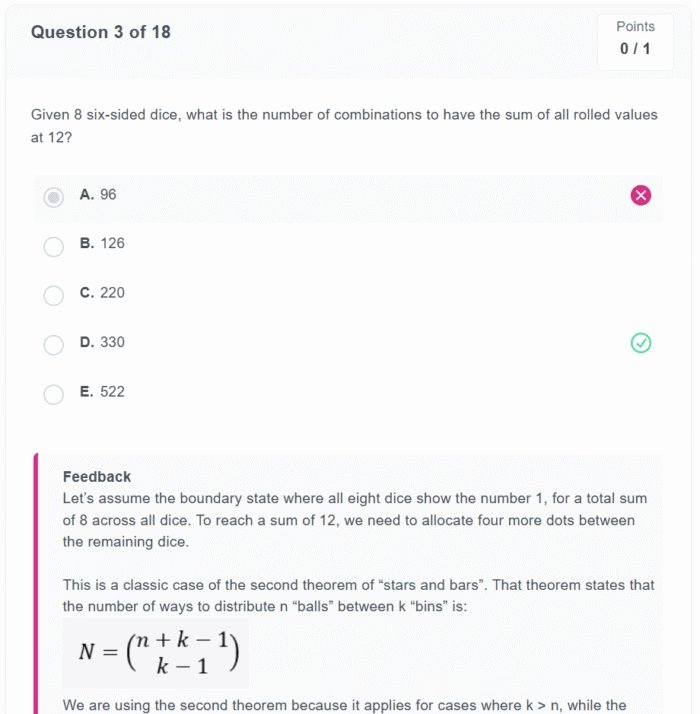
Each practice test matches the actual test in terms of topics, level of difficulty, and number of questions (18).
Taken on the third-party website Classmarker, a trusted testing platform for over 15 years.
Super-Tailored Questions
Focus on probability and combinatorics, as on the actual assessment.
Covers the most important topics (combinatorics, common probability models and distributions).
4 Additional Practice Tests
Strengthen your skills with 40 extra questions tailored to assessments of major trading firms (SIG, Maven, Optiver).
Divided into basic / intermediate level.
Answers and explanations included.
Detailed Feedback to All Questions
Review your answers correct answers after the test + detailed explanations.
Score reports emailed to you.
Easy Access
30-days access to all prep material.
Maven Probability Test Preparation
2 authentic mock practice tests (36 questions total)
4 additional Probability for Trading practice tests (40 questions total)