The Balance test is one of the more challenging tests in Arctic Shore’s collection of gamified mini tests.
The test contains around 10 questions (exact number may vary) and assesses your quantitative and logical skills with a focus on quick problem-solving. You will have only 60 seconds per question.
Question Structure and Format
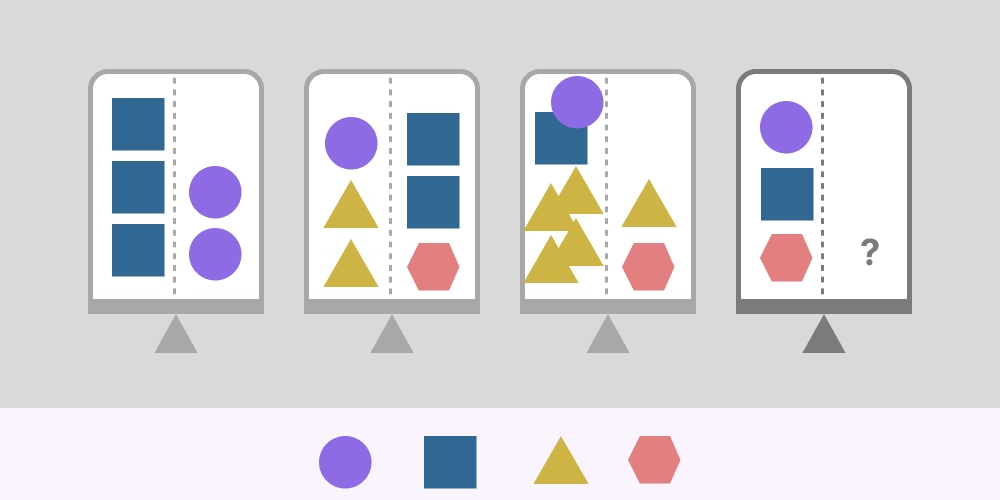
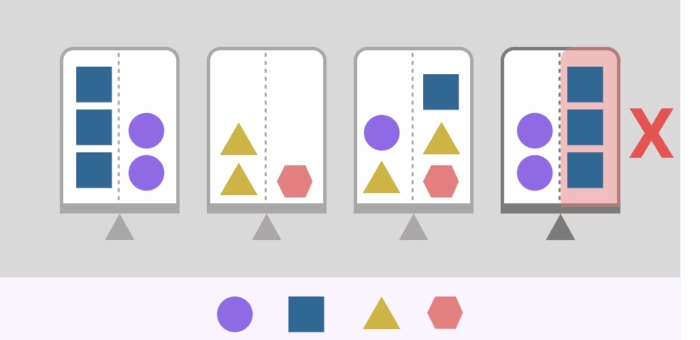
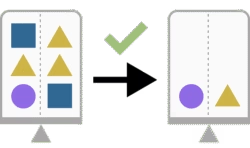
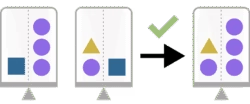
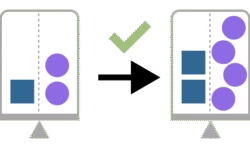
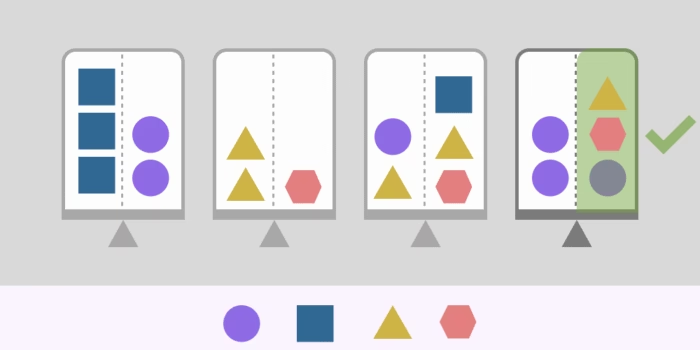
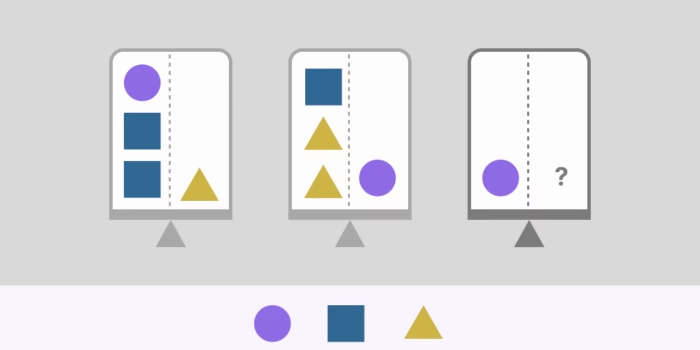
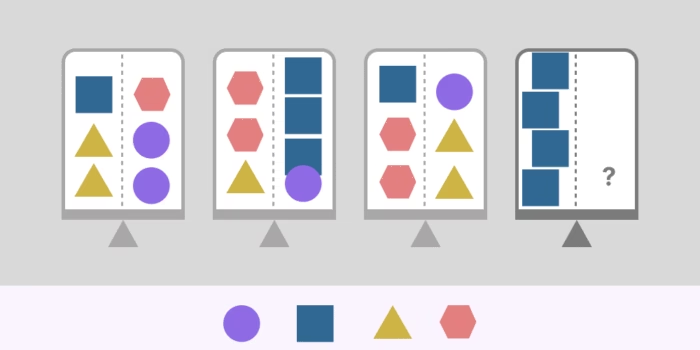
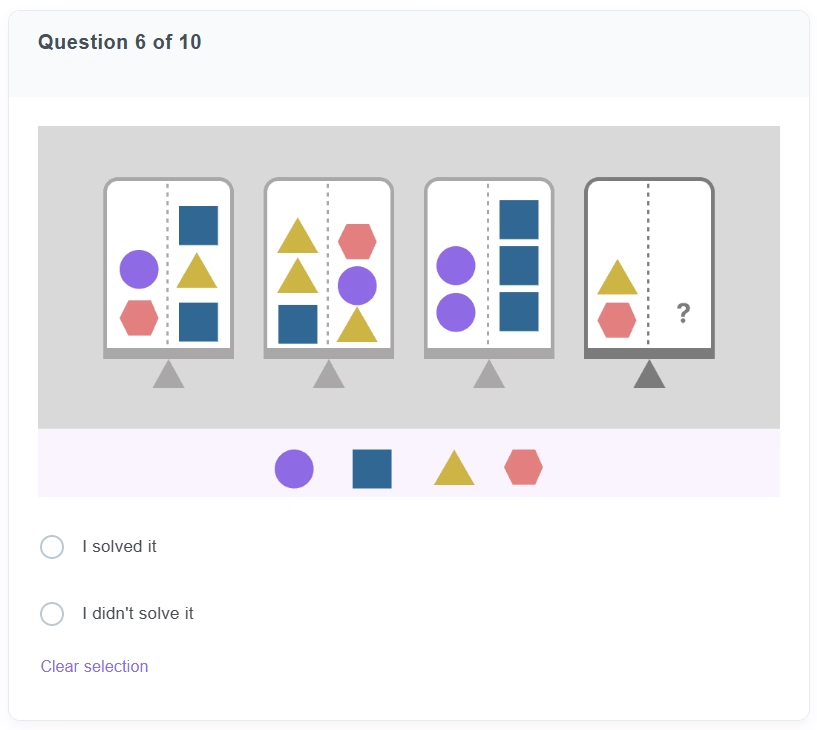
Each question looks as follows:
By analyzing the data in the scales to the left, you will need to fill in the shapes to balance the scale to the right.
The test is adaptive – solve a question correctly, and the next question will be more challenging. Solve incorrectly, and you get a simpler question.
Each test resembles the real Balance Game content and level of difficulty (test non-interactive).
Detailed answers and explanations to all questions
Additional PDF study guide with multiple tips and tricks
30-day access
If you purchase JobTestPrep’s Arctic Shores Preparation through my affiliate link, send the confirmation to info@aptitude-test-prep.com and get the prep for FREE!
In this section, we’ll quickly review what you can and can’t do when solving Arctic Shores Balance Test equations.
What You CAN’T Do
Choosing a Trivial Solution (Given in Data)
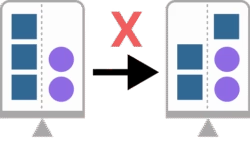
In your answer, you may not repeat the data already presented to you.
For instance, the answer below will not be valid, and you will be shown an error prompt.
Moving Shapes from One Side of the Scale to the Other
Obviously, by moving a shape from one side of the scale to the next will cause the scale to cease being balanced.
This may seem self-evident, but you’ll be surprised by the errors you could make under time pressure.
Working with Only a Part of the Scale Content
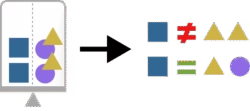
You cannot make assumptions on variables based on partial content of a scale (unless one variable is an integral multiple of the other.)
What You CAN Do
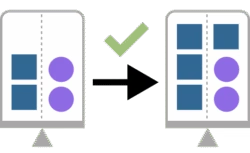
Adding the Same Shapes to Both Sides of the Scale
It’s the same as adding a term to both sides of the equation.
Removing the Same Shapes from Both Sides of the Scale
It’s the same as canceling a term from both sides of the equation.
Swapping Equivalent Shapes
Same as substituting a value into an equation.
Multiplying Both Sides by a Coefficient
Similarly, same as multiplying both sides of an equation.
Using the Shape/s Already in Question
This is a tricky one.
Unless you’re giving the trivial solution (see above), you definitely can use the shapes already given in the question.
Free Practice
This practice test contains 3 sample questions – basic, intermediate, and advanced. I’ll be using some tricks from the tips section, so you can either check them out now or review them after solving the samples.
Either way, it’s recommended to check out the test rules section before solving these.
Good luck!
Question 1 – Basic
Answer and Explanation
Quick Solution
Formulating equations:
t + c = 2s
t + 3s = 2c
c = ?
Where:
s = square
c = circle
t = triangle
2s stands as a convenient swap. Let’s substitute it into equation II:
t + 2s + s = 2c
t + (t + c) + s = 2c
Rearranging:
c = 2t + s
So, one circle is equivalent to two triangles and one square.
Full Solution
To understand the range of all possible answers, let’s walk through a full mathematical solution.
Again, the equations were:
t + c = 2s
t + 3s = 2c
c = ?
We will assign the value 1 to a random variable. To increase solving speed, it is recommended that this variable is different to the one we are required to find (i.e., circle) – if possible.
Let’s choose the square. s = 1.
That yields two equations:
t + c = 2
2c = 3 + t
By adding I and II:
t + c + 2c = 5 + t, and hence, 3c = 5
c = 5/3
Since c is not an integer, we cannot use only s to determine it, and will need to find t as well:
Substituting c into equation I:
t + 5/3 = 2, and hence, t = 1/3
After normalizing all variables by multiplying by 3, we get:
c = 5, s = 3, t = 1
The value we are looking for is c, which equals 5, and so, any combination that satisfies the following condition is correct:
5 = 5⬤ + 3■ + ▲
Question 2 – Intermediate
Answer and Explanation
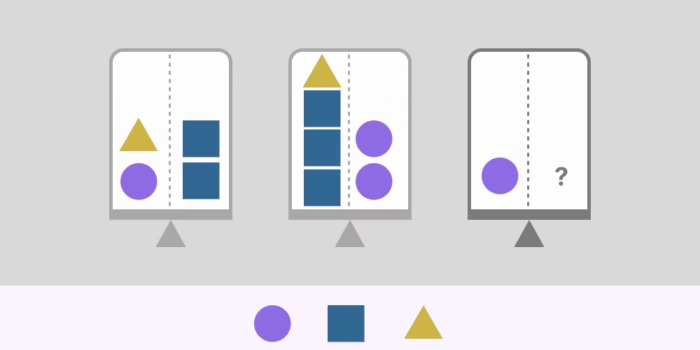
This question reveals us to a new notion which many candidates might struggle with at first glance:
Shape values can be negative.
Also, note that the answer ▲▲+■ = ⬤ is invalid, as it’s a trivial solution already given in the data.
Quick Solution
Formulating equations:
c + 2s = t
s + 2t = c
c = ?
Let’s substitute c from I into II:
s + 2t + 2s = t
t = -3s
At first glance, this doesn’t seem to be useful at all. How can we put minus three squares on the scale? (Remember that in the actual assessment, you can put shapes only on one side of the scale!)
However, we can easily convert this result into a “zero combination” (check out the tips section):
t + 3s = 0
So, adding this combination to the original shape creates a perfectly balanced scale:
c = c + t + 3s (one circle, one triangle, and three squares).
Full Solution
Our equations are:
c + 2s = 1
s + 2 = c
Again, let’s assign a random shape the value 1 (again, preferably, another shape than the one we need to discover), say the triangle.
t = 1
Substituting c into equation I:
s + 2 + 2s = 1, hence 3s = -1
s = -1/3
And again, substituting s into equation II:
c = 5/3
Normalizing:
c = 5, t = 3, s = -1
The value we are looking for is c, which equals 5, and so, any combination that satisfies the following condition is correct:
5= 5● + 3▲ – ◼
Question 3 – Advanced
Answer and Explanation
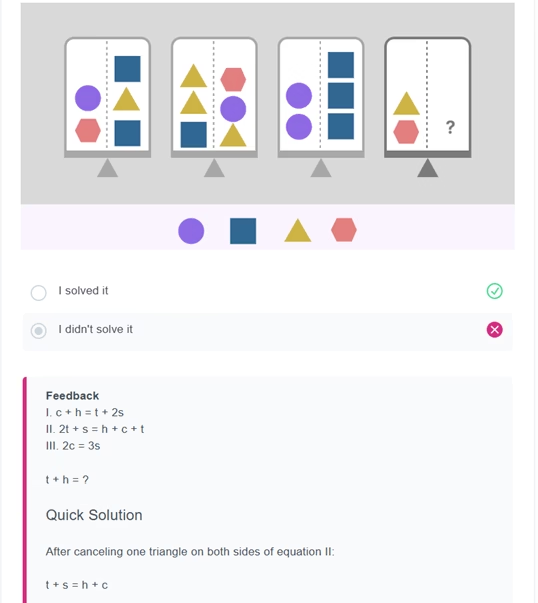
2t + s = h + 2c
t + 2h = 3s + c
2h + s = 2t + c
4s = ?
Quick Solution
These equations contain multiple possible swaps. In this example, we want to cancel as many shapes as possible, excluding the square.
For that purpose, the most convenient swaps are either c or 2h. Let’s go with c:
From II:
c = t + 2h – 3s
Substituting in III:
2h + s = 2t + t + 2h – 3s
Rearranging:
4s = 3t (three triangles)
Full Solution
Continuing with what we already know from the quick solution: t = 4s/3
Assigning s = 1:
t = 4/3
Subtracting two times equation II from I will help us cancel both c and t:
I – 2 x II:
2t + 1 – 2(t + 2h) = h + 2c – 2(3 + c)
2t + 1 – 2t + 4h = h + 2c – 6 – 2c
h = 5/7
And plugging all known values into III to extract c:
2 x (5/7) + 1 = 8/3 + c
c = -5/21
For convenience, we can normalize all values by multiplying by 21
s = 21, t = 28, h = 15, c = -5
The value we are looking for is four squares (4s), which equals 4 x 21 = 84. And so, any answer that satisfies the following condition is correct:
84 = 15⬢ + 28▲ – 5● + 21◼
Examples are:
▲= 3
▲= 3 ; = 3 ; ⬢ = 1
Arctic Shores Balance Game Preparation
What Do You Get?
2 online practice tests (20 questions total)
Each test resembles the real Balance Game content and level of difficulty (test non-interactive).
Detailed answers and explanations to all questions
Additional PDF study guide with multiple tips and tricks
30-day access
If you purchase JobTestPrep’s Arctic Shores Preparation through my affiliate link, send the confirmation to info@aptitude-test-prep.com and get the prep for FREE!
In this section I will provide you with several tips focused on coping with the extremely challenging time frame of the Arctic Shores Balance Test.
These tips may seem a bit vague at first, so make sure you check out how they are applied in practice in the free practice section.
Tip #1 – Master Systems of Equations
In and of themselves, the questions on the Balance Test are very technical and straightforward. If you can solve systems of equations super fast – you’ll basically need nothing else to ace this test.
Focus on 3 equations in 2 variables or 4 equations in 3 variables – that is the majority of what you’ll encounter on the test.
Tip #2 – Look for Repetition
Combinations of shapes that appear more than once have a good potential of being canceled out by substitution or elimination. Look for these patterns, with special care not to cancel the shapes you are looking for (those on the rightmost scale).
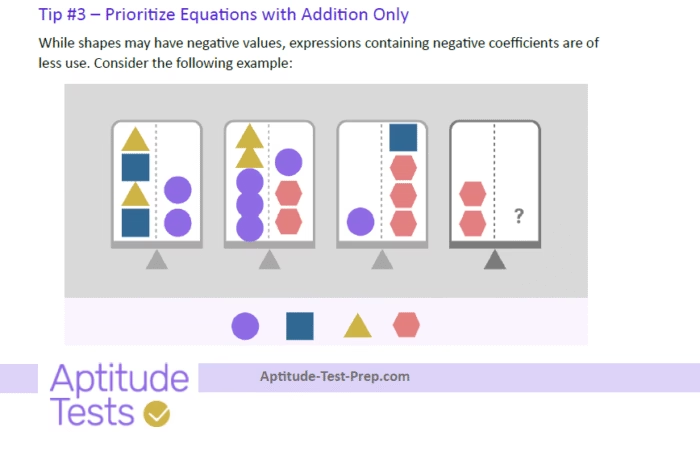
Tip #3 – Look for “Zero Combinations”
Zero combinations are combinations of shapes whose total value is 0.
Getting back to the example from tip 3, we saw that h = -2c.
So, instead, we can rewrite h + 2c = 0.
These expressions are super effective because they can often single-handedly finish a question.
Arctic Shores Balance Game Preparation
AptitudeTestPrep now offers a fully-tailored online preparation for the Arctic Shores Balance Game.
What Does the Preparation Include?
The preparation includes:
2 Practice Tests
Match the actual test in terms of questions (10), content, and question format.
Focus on content. Learn how to effectively approach and solve Balance Game questions.
Taken on the third-party website Classmarker, a trusted testing platform for over 15 years.
Note: The practice test is not interactive and is based on images.
Detailed Feedback to All Questions
Explanations focused on improving solving speed.
Score reports emailed to you.
PDF Study Guide
Covers multiple time-saving tips and tricks.
An essential extra for your success.
Easy Access
30-days access to all prep material.
Arctic Shores Balance Game Preparation
The ONLY prep accurately simulating the assessment.
BEST value for money.
2 authentic mock practice tests (20 questions total) + PDF study guide
Detailed answers and explanations
Focus on effective and quick solving methods
30-days access
If you purchase JobTestPrep’s Arctic Shores Preparation through my affiliate link, send the confirmation to info@aptitude-test-prep.com and get the prep for FREE!
Arctic Shores Balance Test Preparation
2 authentic mock practice tests (20 questions total)