Test geek and founder of Aptitude-Test-Prep.com
What Is the Five Rings Trader test?
The Online Assessment (OA), also referred to as Five Rings Quant Trader Screen, is the first screening stage for trading candidates at Five Rings. Candidates for technical roles will take a different assessment.
The test is administered by HackerRank. Precise number of questions and time limit may vary, but the assessment typically includes 15–20 open-ended quantitative questions to be completed in little less than 20 minutes.
Two main topics are covered:
- Probability and combinatorics
- Estimation and mental math
The drills themselves are very simple, but are done under intense time pressure, with no calculator.
What Does the Five Rings Trader Test Measure?
Rather than testing textbook math knowledge, Five Rings uses math drills to see how your brain operates under pressure:
- Can you spot shortcuts?
- Can you estimate quickly?
- Can you quickly simplify complex problems?
- Can you avoid getting trapped in unnecessary calculations?
Test Structure and Format
There are basically only two topics in the Five Rings math test, but each of them is exceptionally broad, and can hold a tremendous variety of possibilities.
This yet again emphasizes the fact that the purpose of the Technical Screen is to identify quick, creative problem-solvers.
Pro Tip
All that said, you CAN get yourself familiar with common trick questions used in the OA. This will substantially cut down on solving time during the actual assessment.
You can find four such examples below.
Topic #1 – Probability & Combinatorics
These questions do require theoretical knowledge in probability and combinatorics. They will, most commonly, rely on basic probability models such as coin tosses and dice rolls.
Sample Question 1
Six six-sided dice are rolled. What is the probability that exactly 4 rolls are odd?
Answer and Explanation
This question can be modelled by binomial distribution:
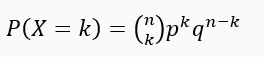
The probability of each die roll being odd is naturally ½, so:
Additionally we know:

Sample Question 2
How many ways are there to arrange 5 distinct books on 3 shelves, so that no shelf is left empty? The order of the books on the shelf doesn’t matter.
Step 1 – Total Combinations
Since there are no restrictions on the arrangements, and no placement depends on the previous ones, the number of total possible arrangements is 35 = 243.
Step 2 – Combinations with an Empty Shelf
If we choose one shelf to be empty, we have 2 shelves left to arrange the books. The number of ways to choose which shelf is empty is, naturally, 3.
Therefore, the possible number of ways of arranging the 5 books on the two remaining shelves is therefore: 3·25 = 96
Step 3 – Consider Double Count
The 96 cases also include cases where two shelves are empty (i.e., all books go to the same shelf). But we have subtracted each such case twice.
For instance, the case “all books are on shelf A” (i.e., shelves B and C are empty) appears twice:
- Once in the list of “shelf B is empty”.
- Once in the list of “shelf C is empty”.
There are three such cases (one for each shelf): 3·15 = 3
Step 4 – Subtract and Add
The total number of possible arrangements is 243 – 96 + 3 = 150
However, it can be safely assumed that an answer of 147 (243 – 96), while not 100% accurate, is an acceptable answer which demonstrates the ability to correctly model and simplify the problem.
Bonus: Solving with Inclusion-Exclusion
Steps 2-4 (the number of “bad” cases) can also be explained with the inclusion-exclusion formula for 3 sets:
∣A∪B∪C∣=∣A∣+∣B∣+∣C∣−∣A∩B∣−∣A∩C∣−∣B∩C∣+∣A∩B∩C∣
Where:
- A – Shelf A is empty
- B – Shelf B is empty
- C – Shelf C is empty
∣A∣ = ∣B∣ = ∣C∣ = 25 = 32
∣A∩B∣ (shelves A and B are empty) = 1
Therefore:
∣A∩B∣ = ∣A∩C∣ = ∣B∩C∣ = 1
And, finally:
∣A∩B∩C∣ (shelves A, B, and C are empty) = 0
And so, the total number of “bad” cases is:
32 + 32 + 32 – 1 – 1 – 1 = 93
Topic #2 - Estimation and Mental Math
This section requires less theoretical knowledge, yet a greater extent of problem-solving and creativity. These questions will require you to quickly find a simplified model of the problem and solve THAT.
Sample Question 3
What is the arc length of x2 between 2 and 3?
Answer and Explanation
Directly calculating the length of an arc is a complicated process involving advanced integration. Even a simple function like x2 would require quite a long, complex process incorporating the inverse hyperbolic function arcsinh.
However, we can come very close to the correct answer by simply looking at the chord connecting the two points on the x2 : (2,4) and (3,9).
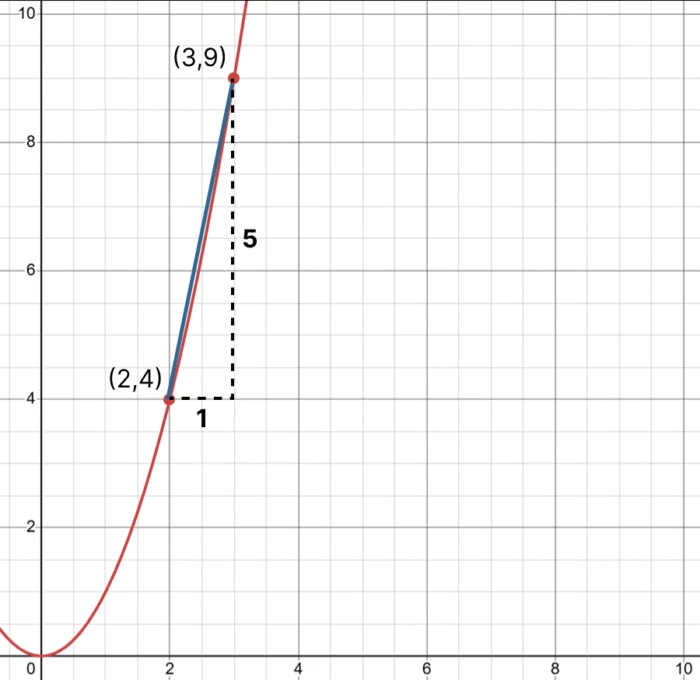
Since x2 is convex and monotone, the chord is always above the arc and hence provides a lower bound for its length.
That length is:

From the plot above, we can see that the actual length of the arc is very close to that, but let’s consider an upper bound as well.
Since x2 is monotone, the lower bound is ∆x + ∆y = 1 + 5 = 6.
So, if your answer is anywhere between 5.1 and 6, you got it right, but the closer you are to 5.1, the better.
Note: If the actual length of the arc interests you, you can check it out here.
Sample Question 4
Given all integers between 1 and 100.
- SO – Sum of all odd integers
- SD – Sum of all dual integers
SO – SD = ?
Answer and Explanation
We’ll use two methods to solve this question.
Method #1 – Sum of an Arithmetic Progression
All dual integers 1-100 are an arithmetic progression with a1 = 2, a50 = 100, n = 50.
So:
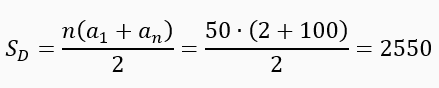
Similarly:

So, SO – SD = 2500 – 2550 = –50
Method #2 – “Pairs”
Let’s look at the first two pairs of numbers.
Odd: 1 + 3 = 4
Dual: 2 + 4 = 6
Odd – Dual = –2
This pattern goes on for each and every pair:
[(5 + 7) – (6 + 8)] = [(9 + 11) – (10 + 12)] = …. = –2
Since there are 25 pairs, the total difference is 25 x (–2) = –50
Personalized Consultation
I now offer 1-on-1 personalized online consultation sessions. For details and pricing, see here.

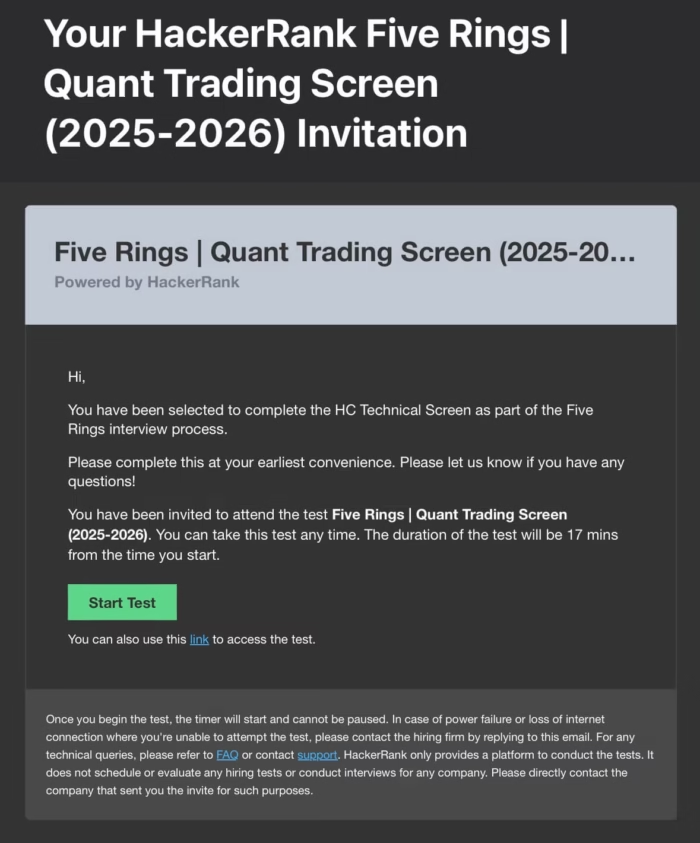
Test Invitation
If you’ve successfully passed the initial application screening, you’ll get a test invitation shortly afterwards.
Test results usually arrive within a few days, inviting successful candidates to the next screening stage – live probability interviews with traders.
Test Interface
The Five Rings online assessment is conducted on HackerRank.
The assessment is hosted on HackerRank. Here’s what you can expect:
- Proctored assessment
- One question displayed at a time
- Visible countdown timer
- No answer choices
- Typed numerical responses (most commonly, accuracy up to the 2nd decimal place or the closest integer).
- No calculators are allowed