Test geek and founder of Aptitude-Test-Prep.com
What Is the Flow Traders OA?
The Flow Traders Online Assessment is a quantitative aptitude test used to screen candidates for trading roles.
Hosted on Trading Interview, the test evaluates 2 core competencies often considered a prerequisite for trading – quick numerical calculation and pattern recognition.
The assessment consists of two sections:
- Mental Math Test (60 questions in 6 minutes)
- Sequences (25 questions in 26 minutes)
Test Structure and Format
Mental Math Test
A high-speed mental arithmetic assessment.
- Number of questions: 60
- Time Limit: 6 minutes
- Question Types: Integers, decimals, fractions, and basic arithmetic
- Answer Format: Multiple-choice
The challenge is not necessarily the mathematical difficulty of the questions, but the extreme speed required to complete them accurately, with an average of just 6 seconds per question.
Sequences Test
A logical reasoning and pattern recognition abilities assessment.
- Number of questions: 25
- Time Limit: 26 minutes
- Question Types: Number sequences, letter patterns, and logical progressions
- Answer Format: Multiple-choice
Here, the time limits are far less stringent. As such, the main challenge is the ability to quickly identify underlying patterns, some of which can be very complex.
Flow Traders Test Preparation
I recommend TradingInterview Flow Traders Test Preparation. TradingInterview is the official Flow Traders assessment provider.
What Do You Get?
Mental Arithmetic Test
- The actual Flow Traders math test format, hosted by Trading Interview
- Customisable exercises targeting your specific weak areas
Sequences Test
- Flow Traders-specific sequences practice at multiple difficulty levels
- Tips and tricks for recognising sequence types quickly
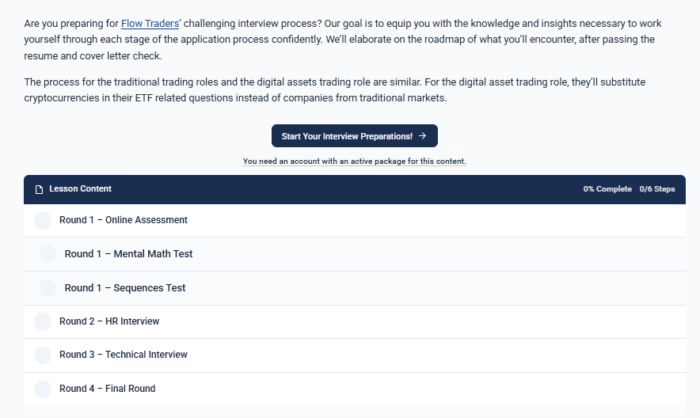
Next Step Prep – Full Interview Preparation
- A complete roadmap of the Flow Traders hiring process, stage by stage
- Probability questions, market making games, brain teasers and interview questions for the interview rounds
Start Preparing Now
Full Disclosure: I am are affiliated with TradingInterview. Clicking the links helps me provide you with high-quality, ad-free content.
Test Invitation
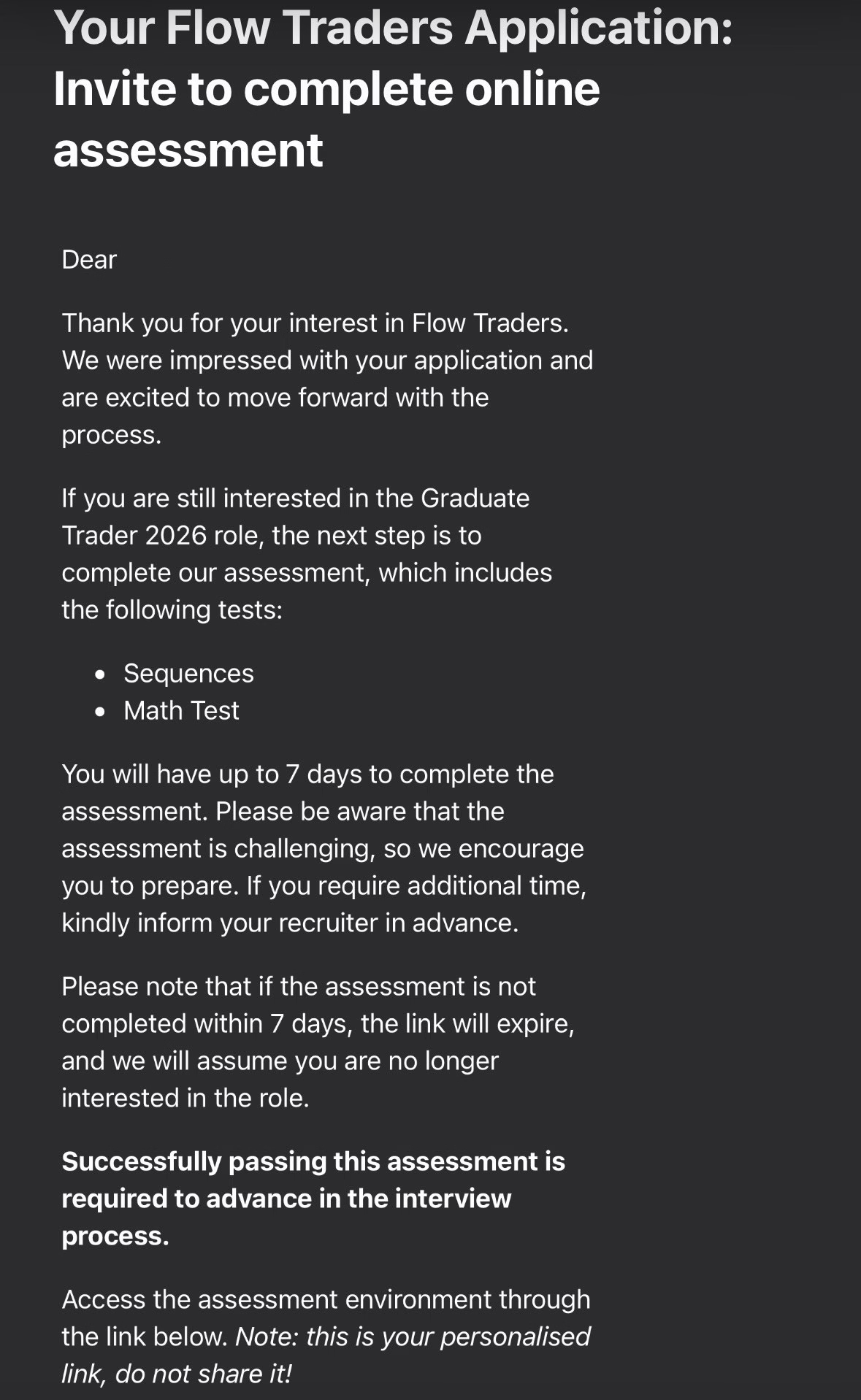
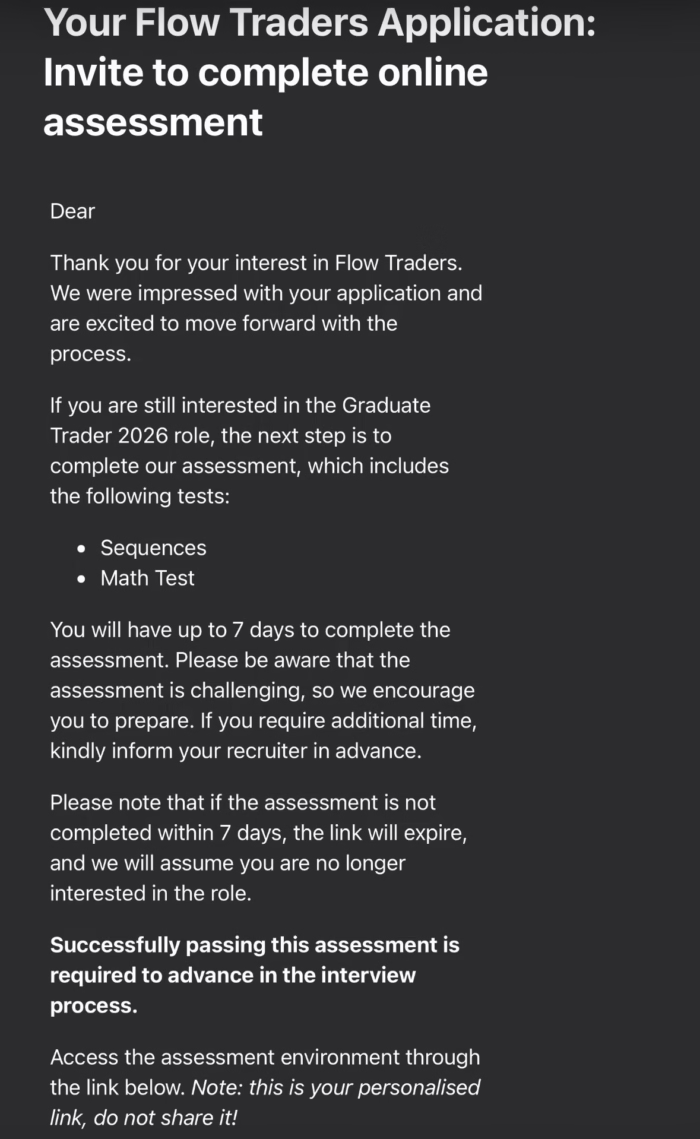
Candidates typically receive the Flow Traders OA shortly after submitting an application through the official Flow Traders careers portal.
You usually have up to 7 days to complete the assessment after receiving the invitation email.
The test is completed remotely through the Dutch firm Trading Interview, which also offers a prep course for the assessment.
Free Practice
This free practice is divided into two parts:
- Calculations – You don’t need me to teach you how to calculate. Instead, I’ll show you some of the common tricks used in the Calculations section to increase difficulty.
- Sequences – intended to demonstrate the expected level of difficulty and share some inside tips.
Good luck!
Question 1 – Calculations
0.75 + 4.87 = ?
- 5.72
- 5.62
- 5.82
- 5.92
Tailored Tip
Several tricks and hacks can take advantage of the multiple-choice format of the test. Most candidates are familiar with the last digit trick, but that becomes useless when multiple options have the same last digit, as in this case.
So, we’ll need to use the second-last digit trick. The tens digit should be:
7 + 8 = 15
To that we’ll need to add the “1” from the ones, since 7 + 5 > 10.
So, 5 + 1 = 6, and the correct answer is B.
Question 2 – Calculations
2,500 x 500 = ?
- 12500
- 125000
- 1250000
- 12500000
Tailored Tip
Using large numbers is another method the test will use to trick you. Make sure you choose the correct number of zeroes!
Question 3 – Calculations
0.04 x (50 ÷ 4) = ?
- 0.2
- 0.25
- 0.5
- 5
Tailored Tip
Three operations in a row are another common technique. Intuitively finding the most convenient order of calculation will save valuable time. For instance, in this example: (0.04 ÷ 4) x 50 = 0.5
Question 4 – Sequences
1, 4, 10, 20, 35, 56, 84, ?
- 108
- 112
- 120
- 210
Answer and Explanation
The correct answer is C.
To solve this problem, we need to find the second series of differences:
1 4 10 20 35 56 84 120
3 6 10 15 21 28 36
3 4 5 6 7 8
Question 5 – Sequences
1.333, 1.25, 1.2, 0.875, 0.8889
- 0.78
- 1.11
- 0.9
- 0.85
Answer and Explanation
The correct answer is C.
This sequence looks very weird, until you turn it into fractions:

As you can see, both the nominator and the denominator increase by 1 with each step.
Question 6 – Sequences
18, 225, 22, 13, 45, 16, 8, 9, 10, ?
- 3
- 17
- 25
- 42
Answer and Explanation
The correct answer is A.
This particularly annoying sequence is a combination of three different sequences:
18, 225, 22, 13, 45, 16, 8, 9, 10,
- The black sequence decreases by 5 with each step.
- The red sequence is divided by 5 with each step.
- The green sequence decreases by 6 with each step.
The next number will belong to the black series and is therefore 8 – 5 = 3.
Flow Traders Test Preparation
I recommend TradingInterview Flow Traders Test Preparation. TradingInterview is the official Flow Traders assessment provider.
What Do You Get?
Mental Arithmetic Test
- The actual Flow Traders math test format, hosted by Trading Interview
- Customisable exercises targeting your specific weak areas
Sequences Test
- Flow Traders-specific sequences practice at multiple difficulty levels
- Tips and tricks for recognising sequence types quickly
Next Step Prep – Full Interview Preparation
- A complete roadmap of the Flow Traders hiring process, stage by stage
- Probability questions, market making games, brain teasers and interview questions for the interview rounds
Start Preparing Now
Full Disclosure: I am are affiliated with TradingInterview. Clicking the links helps me provide you with high-quality, ad-free content.
Scoring and Test Interface
Test Interface
- One question displayed at a time
- Multiple-choice
- A visible countdown timer
- No calculator allowed
- Skipping questions – not allowed in the math test, allowed in the sequences test.
Scoring
The Flow Traders math and sequences tests use a negative marking system, in which:
- Correct Answer: +1 point
- Incorrect Answer: -1 point
- Unanswered Question: 0 points
Because wrong answers reduce your score, blind guessing can be risky.
You may not skip questions in the math test, so for each question you solve, you’ll get either +1 or -1. When the time is up, any question you did not get to answer will gain no points.
In the sequences test you do have the option to skip questions and leave them unanswered.
Based on candidate reports, a score of approximately 72 points (around 60%) is considered competitive for passing the math section. Many candidates aim to consistently score around 80 points during practice in order to account for stress and performance drops during the real assessment.
FAQs
This section summarizes key points reviewed in previous sections.
What Is the Flow Traders Online Assessment?
The Flow Traders OA is a two-part quantitative screening test. It consists of a Mental Math Test (60 questions, 6 minutes) and a Sequences Test (25 sequences, 26 minutes), both designed to assess speed, accuracy, and reasoning under pressure.
What Topics Are Covered in the Flow Traders OA?
The Flow Traders Math Test focuses on basic arithmetic, including integers, decimals, and fractions. The Sequences Test covers number sequences, letter patterns, and logical progressions. No advanced mathematics is required, but exceptional speed is essential.
How Difficult Is the Flow Traders OA?
The test is widely considered demanding, primarily due to the time pressure rather than the complexity of individual questions.
Is a Calculator Allowed During the Assessment?
No. The use of calculators is not permitted during either section of the Flow Traders assessment. You are allowed to use a pen and paper, though.
What Does the Flow Traders Application Process Look Like?
The Flow Traders application process typically begins with an online application and resume screening. Candidates who progress are invited to complete the Online Assessment, which evaluates quantitative reasoning and pattern recognition under time pressure. Those who perform well may then advance to additional interview stages, including technical and trading-focused discussions.