Test geek and founder of Aptitude-Test-Prep.com
What Is the Hogan MVPI Test?
The Hogan MVPI (Motives, Values, Preferences Inventory) test is a personality test aimed to assess one’s interests, goals, and values, especially in a job-related setting.
The test contains 200 statements and is officially untimed. You are expected to complete the test within around 20 minutes.
Employers mostly use the MVPI test to evaluate a candidate’s match to their organizational culture and values.
Test Structure and Question Format
The Hogan MVPI Test contains 200 statements describing you. You should mark the statement as either “Agree”, “Disagree”, or “Uncertain”.
Here are some examples for statements that may appear on the assessment:
- I prefer sticking to a plan.
- Science is the only way to advance society.
- Most of my friends are kind people.
Being a personality profiling test, answers to particular questions on the Hogan MVPI test are meaningless. What matters is your overall profile. In the Free Practice section, you can find a detailed overview of sample questions and recommended answers.
What Does the Hogan Personality Assessment Measure?
The Hogan Motives, Values, Preferences Inventory assesses 10 main scales. Each of these scales is divided into 5 aspects, referred to as subscales, which repeat across all scales.
MVPI Main Scales
The 10 main MVPI scales measure basic values upon which people base their preferences and motives. These are:
- Aesthetics – appreciation and concern for beauty, design, and self-expression.
- Affiliation – enjoyment and need for social interaction.
- Altruistic – the will to help other individuals and society as a whole.
- Commerce – interest in money and possible profits and opportunities.
- Hedonism – inclination to seek fun and pleasure.
- Power – desire for control, influence, and status.
- Recognition – tendency to value and seek attention and approval.
- Science – interest in knowledge, research, and technology.
- Security – the need for stability and predictability.
- Tradition – personal commitment to one’s own beliefs.
MVPI Subscales (Themes)
Each of the 10 main scales is divided into 5 subscales. These indicate in what aspects of life the main scale comes into play.
Below is a quick overview of the five subscales, with examples specifically related to the main scale of Power.
Aversions
You hold negative views towards things or people that contradict this value.
Example in the Power trait: “I dislike people who are happy being told what to do.”
Beliefs
You base universal ideals and life goals on this value.
Example in the Power trait: “I strive to have a major impact on others.”
Lifestyle
You actively live a lifestyle that follows this value.
Example in the Power trait: “Within a group, I usually take the lead.”
Occupational Preferences
You seek a career that is characterized by this value.
Example in the Power trait: “My idea of a career is senior management.”
Preferred Associates
You wish to interact with people sharing the same value.
Example in the Power trait: “I surround myself with influential people.”
Personalized Consultation
I now offer 1-on-1 personalized online consultation sessions. For details and pricing, see here.

MVPI Test Interface
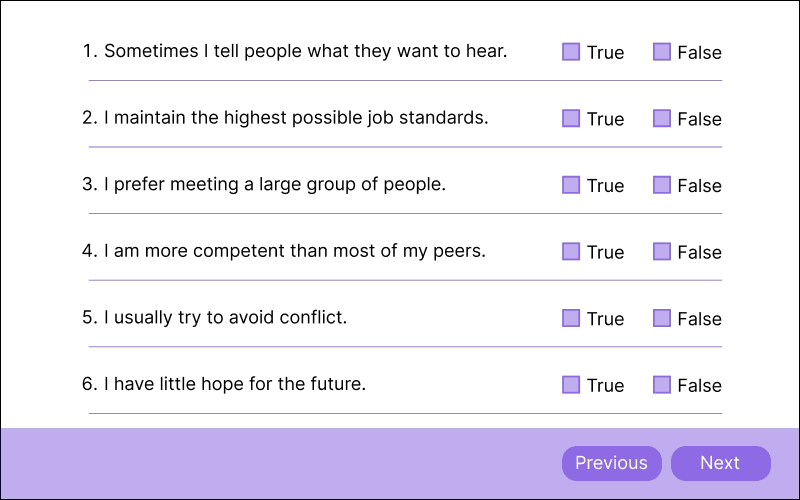
The interface of the MVPI test is similar to other Hogan tests, with the exception of 3 answer options instead of 2:

- Each screen contains several statements about you (usually 6).
- Each statement is related to one of 10 main scales, divided into 5 subscales/themes.
- Unlike in the HPI or the HDS, every main scale has the same 5 subscales. (Read more about scales in the Test Overview section.
- Statements can be marked as either “Agree”, “Disagree”, or “Undecided”.
- Your scale and subscale scores are determined by the number of “True” choices. See more in the the Scoring section.
- You can go back to previous screens and change answers (but that’s usually not recommended).
Hogan MVPI Free Sample Practice Test
This section contains several sample questions adapted from the Hogan MVPI.
However, since the MVPI is a very personal test that mostly assesses your personal preferences, we are not going to give any answer recommendations.
The main issue here is to identify which scale and subscale are represented by each statement.
Good luck!
Statement #1
I prefer working in a place where results are available for everyone to see.
Scale and Subscale
Scale: Recognition
Subscale: Occupational Preferences
Statement #2
Most of my friends are party-people.
Scale and Subscale
Scale: Hedonism
Subscale: Preferred Associates
Statement #3
I do my best to help others whenever I can.
Scale and Subscale
Scale: Altruism
Subscale: Lifestyle
Statement #4
A stable life is a better life.
Scale and Subscale
Scale: Security
Subscale: Beliefs
Statement #5
I dislike people who do not like reading.
Scale and Subscale
Scale: Science
Subscale: Aversions
MVPI Test Scoring
How Is the Hogan MVPI Test Scored?
The MVPI is scored similarly to the two other Hogan personality tests – the Hogan HPI and the Hogan HDS. That is intended to maintain consistency among the different tests, in order to provide employers with a unified image of every candidate.
Here’s how the scoring for an MVPI scale generally looks like:

These are the basics (all information is adapted from the Hogan Subscale Interpretation Guide):
- The MVPI assesses 11 main scales, divided into 33 subscales.
- Each statement is related to one subscale and one main scale.
- Each subscale on the test contains between 3 and 6 statements.
- For every statement you mark, you get points for that subscale. Hogan does not reveal how many points are gained, but according to their scale interpretation guide, it sems that “Disagree” earns one point, “Undecided” earns 2, and “Agree” earns 3.
- For instance, marking “Disagree” in the statement “A stable life is a better life” will gain you one point for the Beliefs subscale in the Security main scale.
- The calculated score is a combination of your raw scores on the subscales with a percentile score on the main scale.
- The subscale scores provide extra interpretation and depth for the main scale scores.
What Is a Good Score on the MVPI Test?
That question is very tricky in personality tests, and it is extra tricky in the case of the MVPI. That’s because while we can very intuitively pass judgment on more and less desirable personality traits, there really aren’t “preferable” values and motives.
It is important to remember that the Hogan MVPI test is used as an additional tool for gaining further insight on candidates, and not as a standalone test.
MVPI Test Tips
Considering all the unique features of the Hogan MVPI Test, there really are only two tips we can give you:
Tip #1 – Learn About Other Hogan Tests
The MVPI is almost never taken alone, but in conjunction with other Hogan tests. Most commonly, these tests are Hogan’s other personality tests, the Hogan Personality Inventory (HPI) and the Hogan Development Survey (HDS).
If you are applying for a management position, you are also likely to take the cognitive Hogan Business Reasoning Inventory (HBRI) test.
Read more about these tests, that will have a much greater impact on your overall chances of success in the hiring process.
Tip #2 – Consider Your Employer’s Organizational Culture
Nearly every major employer has an organizational culture / values / mission statement page. This page details the company’s values and the kinds of traits they want their employees to have.
The employer’s values page is always a good place to look at when applying for a job – and it can offer a great starting point as to what values and motives the company is after.
MVPI Test Preparation
At the moment, I recommend JobTestPrep’s Hogan Preparation Bundle for your Hogan assessments, with one caveat:
The preparation does not follow the actual assessment’s True/False format. Instead, it uses a traditional Likert scale formatting.
However, other than that, it is currently the most accurate and professional prep available today.
- It is based on Hogan’s actual scales and scoring framework.
- It covers ALL Hogan assessments (HPI, HDS, MVPI, HBRI).
- You can add, at a discounted price, preparation for tests often taken in conjunction with Hogan assessments (Raven APM and SJT).
Start Preparing Now
Full Disclosure: I am affiliated with JobTestPrep. Clicking the links helps me provide you with high-quality, ad-free content.